Alberta White Spruce Tree Information
Images of Alberta White Spruce:
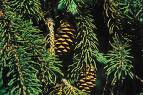
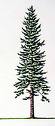
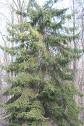
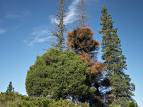
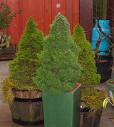
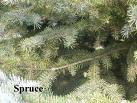
Alberta White Spruce grows in the following 21 states and provinces:
Alaska, Alberta, British Columbia, Maine, Manitoba, Michigan, Minnesota, Montana, New Brunswick, New Hampshire, New York, Northwest Territories, Nova Scotia, Ontario, Prince Edward Island, Saskatchewan, South Dakota, Vermont, Wisconsin, Wyoming, YukonInformation about Alberta White Spruce:
The Picea Glauca is commonly known as the Alberta Spruce, Alberta White Spruce, Black Hills Spruce, Canadian Spruce, Cat Spruce, Porsild Spruce, Skunk Spruce, Western White Spruce as well as White Spruce.
The currently accepted scientific name of white spruce is Picea glauca (Moench) Voss . The genus Picea consists of about 30 species of evergreen trees found in cool, temperate regions of the northern hemisphere. Seven species of Picea, including white spruce, are native to North America. White spruce is widely distributed across northern North America and exhibits considerable geographic variation. However, Little thinks it unnecessary to distinguish varieties, although up to four have been recognized by various other authorities. Natural hybridization between species of Picea is common. Engelmann spruce (P. engelmannii) x white spruce hybrids are common where the ranges of these species overlap. Natural crosses between these species occur from central British Columbia as far south as eastern Washington and Yellowstone National Park . Within this area trees at low elevations closely resemble pure white spruce, while pure Engelmann spruce tends to dominate at higher elevations. Hybrids between the species are concentrated on intervening slopes. Sitka spruce (P. sitchensis) and white spruce are sympatric in northwestern British Columbia and southwestern Alaska. Hybrids occur in this area of sympatry, and have been classified as Picea X lutzi Little. Hybrids between black spruce (P. mariana) and white spruce are relatively rare .White spruce has a transcontinental distribution. It grows from Newfoundland, Labrador, and northern Quebec west across Canada along the northern limit of trees to northwestern Alaska, south to southwestern Alaska, southern British Columbia, southern Alberta, and northwestern Montana, and east to southern Manitoba, central Minnesota, central Michigan, southern Ontario, northern New York, and Maine. An isolated population also occurs in the Black Hills of South Dakota and Wyoming .Climax white spruce forests are widespread across Alaska and northwestern Canada. They consist almost entirely of white spruce, but may have scattered black spruce, paper birch (Betula papyrifera), aspen (Populus tremuloides), and balsam poplar (P. balsamifera) present . Climax stands are often broken up by extensive seral communities resulting from forest fires. In eastern Canada and the northeastern United States, white spruce occurs as a climax species in pure or mixed stands. Within the fog belt of Quebec and Labrador, white spruce forms pure stands near the seaboard . At climax, it often codominates or forms a significant part of the vegetation in mixed stands with red spruce (Picea rubens), balsam fir (Abies balsamea), and black spruce. In the Black Hills, white spruce habitat types occur at high elevations and in cool canyon bottoms . Published classifications listing white spruce as an indicator species or dominant part of the vegetation in habitat types (hts), community types (cts), or ecosystem associations (eas) are presented below: Area Classification Authority AK general veg. cts Viereck & Dyrness 1980 nw AK general veg. cts Hanson 1953 interior AK postfire cts Foote 1983 SD, WY: Black Hills forest hts Hoffman & Alexander 1987 AB general veg. cts Moss 1955 w-c AB forest cts Corns 1983 general veg. eas Corns & Annas 1986 BC: Prince Rupert Forest Region, Interior Cedar-Hemlock Zone general veg. eas Haeussler & others 1985 Prince Rupert Forest Region, Subboreal Spruce Zone general veg. eas Pojar & others 1984 PQ: Gaspe Peninsula forest veg. cts Zoladeski 1988 ON forest eas Jones & others 1983Some of the information provided here is attributed to:Uchytil, Ronald J. 1991. Picea glauca. In: Fire Effects Information System, [Online]. U.S. Department of Agriculture, Forest Service, Rocky Mountain Research Station, Fire Sciences Laboratory (Producer). , available at the USDA Fire Effects Information System (FEIS) website